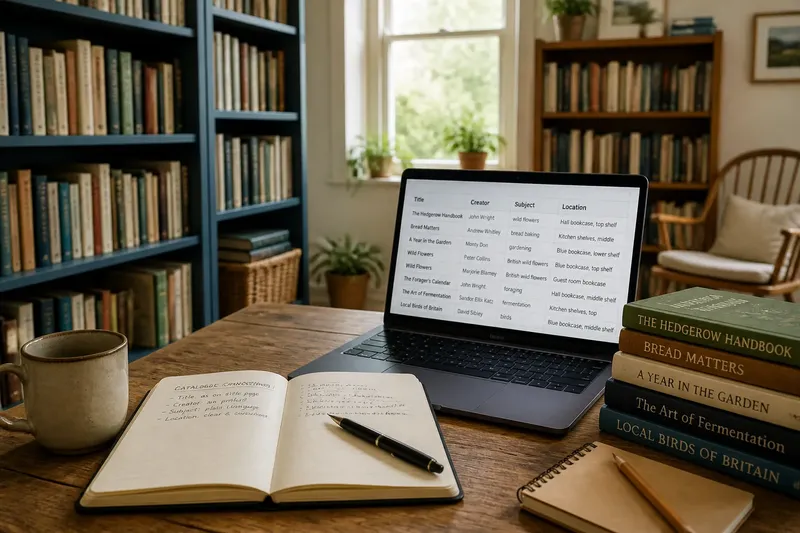
Why Readers Kept Lists of Their Books Before Card Catalogues
See why readers kept book lists before card catalogues, and choose a simple record that helps you remember what you own, read or lend.
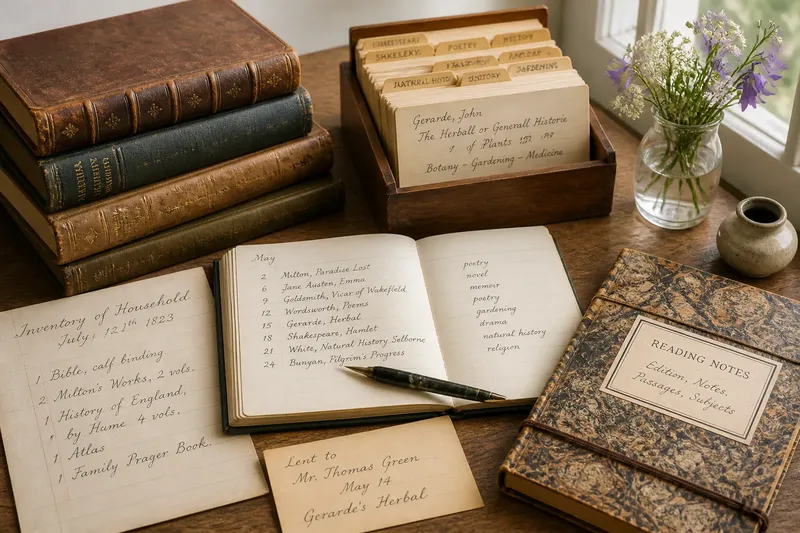
The common mistake with a home book list is to make it a miniature library catalogue, even when the real problem is forgetting who borrowed a favourite novel. A list takes time to write, so it should save time on the question that matters: what do I own, what have I read, or where did that book go? Before the familiar card catalogue, readers used different kinds of records for different needs; the surviving forms do not point to one universal system.
Ownership lists recorded what was present
A handwritten inventory could record books as possessions, alongside other household belongings. Its purpose might be to make ownership visible or help account for property being passed on. A title, author, binding or brief description could identify a volume, depending on what the writer knew and what the record needed to do.
An inventory was often a snapshot rather than a running list. It could say what was present when someone counted the household’s things, without tracking every later arrival or departure. That makes it useful for recording a collection at a particular moment, but less suited to finding a book that has since moved.
Imagine a family writing down inherited belongings before dividing them. One person records a Bible by its distinctive binding and a history by its title; relatives can then discuss which volumes the descriptions refer to. The entries serve that immediate ownership question, not every future search.
For a household record, write descriptions that another family member can recognise.
Reading notes helped people remember more than titles
A record of ownership does not say whether a book has been read. Readers who wanted to recall an edition, a subject or a passage could add notes beside a title. A study notebook might name an author and edition, while a personal list might simply mark a subject or a place to look again.
Extra detail has a cost: it takes longer to enter and may be unclear to someone else. A private symbol can make sense to the person who wrote it, then puzzle a relative sorting the shelves. Add a note when it answers a question you actually ask of your books.
For instance, imagine you have two editions of the same play and often forget which one contains your annotations. You add the edition detail and a note about the marked copy beside the title; the expected result is that you can distinguish the volumes when choosing one to reread.
Record the detail that prevents a real mix-up.
Notebooks suited lists that grew in arrival order
A notebook made it easy to start without designing a whole system. A reader could add a title when a book came home, leave room for comments and keep the record nearby. If entries followed the order books arrived, the notebook also preserved a simple account of how the collection grew.
That order could make later searches slow. An index or a few familiar subject headings might help, but each extra feature needs upkeep. For a short list, scanning several pages may be easier than maintaining a separate index.
Say you have a pocket notebook with titles entered as you borrow or buy books. You add “gardening” in the margin beside a plant guide and “poetry” beside a collection; the expected result is that you can scan those labels to locate books by topic without rewriting the entries. If the labels start to multiply, return to a smaller set you will remember.
Keep a notebook simple enough that you will update it.
Loose cards made rearranging the record easier
A card file allowed each title to sit on its own card. The reader could arrange cards alphabetically by author or group them by subject, then move a card when the arrangement changed. Unlike a notebook page, one new entry did not have to be squeezed between existing lines.
Cards offered flexibility, not automatic organisation. A reader might add author, title and subject details, or make a cross-reference when one book belonged under more than one heading. Each additional entry took effort, and loose cards could be misplaced or mixed up. A labelled box and a consistent way of writing names helped keep the file usable.
Choose cards if you expect to rearrange your list; for a simple running record, a notebook may ask less of you.
Loan notes followed books beyond the shelf
A book list can show that a title belongs to you, but it may not explain why the book is missing from its usual place. A separate loan note answers a different question: who has it? A slip, notebook page or note beside the title can pair the borrower with the book.
Imagine you lend a neighbour a gardening handbook. You write the neighbour’s name and the handbook’s title on a slip and keep it by your reading chair; when you later wonder where the book went, the note points to its borrower rather than leaving you to search the shelves. If your household prefers not to keep names in a shared record, use a private note or agree on another simple reminder.
Write the borrower and title together when a book leaves home.
Which kind of book record answers your question?
Were early home book lists only for scholars?
No single answer fits every surviving record. Household inventories and personal lists could serve different purposes, so it is safer to describe the task each record appears to address than to treat all lists as scholars’ tools.
Was an inventory the same as a card catalogue?
No: an inventory could record what was present at a particular time, while a card file could be rearranged to help locate a title by author or subject. The forms overlap as records of books, but their organisation and purpose can differ.
Why add notes beside a book title?
A note can distinguish editions, recall a reading detail, identify a subject or record a loan. Include it when that information helps you recognise, find or account for the book.
Which record should I use at home?
Choose by the question you need answered: a notebook for a running list, cards for a record you expect to reorder, or a loan note for books away from the shelf. An inventory suits a snapshot of ownership rather than ongoing tracking.
Match the record to the question you ask
These records are easier to compare by purpose than as stages in a single progression. An inventory records ownership at a moment; reading notes preserve details a title cannot; notebooks capture additions in sequence; cards support rearrangement; loan notes track books in other hands. Each form keeps some information and leaves other details out.
When choosing a home book list, start with the moment you most often need help: remembering what you own, finding a title, recalling what you read or locating a loan. For a reader who mainly forgets borrowed books, a small loan note may be more useful than a carefully arranged catalogue. The most useful book list is the one that answers that recurring question with a detail you can recognise later.