Loose Shelves or Numbered Boxes for a Small Collection?
Loose shelves or numbered boxes for a small collection? Compare access, space and label upkeep to choose a storage setup that keeps favourite items easy to find.
The common mistake with a small collection is choosing storage for the moment you put things away, rather than the next time you need them. Loose shelves or numbered boxes can both keep items together, but the wrong choice costs time: something hard to reach or identify may stay forgotten. Match storage to how often you handle the collection, the space available and the effort you want to spend maintaining labels.
Loose shelves or numbered boxes suit different habits
Choose open shelving when you regularly browse, compare or pick out individual items. Choose numbered boxes when you handle the collection less often, need to keep it compact or want to store items as a group. A mixed arrangement often works well: keep frequently used pieces visible and put occasional-use materials in boxes.
Loose shelves means arranging items directly on a shelf, without assigning them a box or storage code. You might sort books by topic, keep fabric swatches in view or line up small craft tools in shallow trays. Numbered storage means placing items in containers identified by a simple code, such as Box 1 or Box 2, and keeping a separate note of what each box holds.
The distinction is not about which method looks tidier. It is about what happens when you want something. If you can recognise an item from across the room and reach it without moving other things, a shelf has an advantage. If materials are used in batches or need protection from dust, a box may be easier to live with.
Open shelves keep often-used items visible
Open shelves generally suit items you reach for repeatedly, because they stay visible and can be returned without opening a container. This can work for reference books, current sketchbooks, regularly used yarn or a small set of samples you like to compare side by side.
Visibility helps only if the shelf is arranged for actual use. Put the most frequently handled items at a comfortable height, leave room to slide them out and avoid stacking small pieces behind taller ones. A shallow basket can corral loose objects while keeping the group easy to see; it needs no number if its contents are obvious.
Open storage can make casual browsing inviting. A distinctive book spine or a folder of colour swatches may catch your eye and prompt an idea. But a packed shelf makes access awkward, and small items can migrate into untidy piles unless they have a clear place to return to.
Say you keep recipe books and a rotating stack of notebooks beside your desk. You put the books spine-out and give the notebooks one shallow tray. The expected result is that you can see what is available and return each piece without assigning every notebook its own code.
Keep the things you reach for most where you can see and retrieve them easily.
Numbered boxes can make occasional-use storage compact
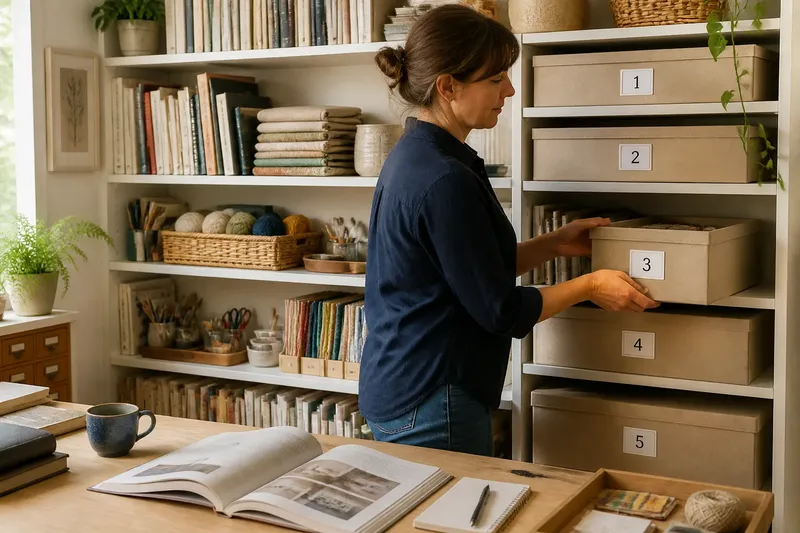
Numbered boxes are useful when items are not needed every day, are awkward to display or would take shelf space you need for other work. Uniform containers can stack in a cupboard or under a table, while a number on each front helps distinguish them.
Boxes are practical for groups used together. Seasonal decorations, spare bookbinding materials or old project samples may be easier to fetch as a whole container than as separate objects. Choose a box you can lift comfortably when filled, and leave room to remove its contents without spreading them across the floor.
Numbering does not make a box’s contents self-explanatory. If Box 3 has only a number on the front, keep a contents note somewhere you can consult without opening every container. A paper list inside a cupboard door can be enough for a small collection. “Linen offcuts and binding thread” is more recognisable than “craft supplies”.
Boxes obscure their contents and can invite overfilling. If a lid will not close easily, or you must move several other containers to reach the one you need, the apparent space saving may cost more effort than it returns. Keep the boxes containing the most-used material at the front or on top.
Compare access, space and label upkeep before choosing
Use these checks to compare options for a particular group of items. For each one, note what you observe and make the matching choice; if the first option does not fit, use the alternative.
- Access: Check whether you reach for the items often and can retrieve them without moving other things. If you use them regularly, put them on an open shelf; if they are occasional-use items, group them in a numbered box instead.
- Visibility: Check whether seeing the items helps you choose or remember them. If it does, keep them visible on a shelf; if visibility adds clutter without helping, use a box and a readable contents note.
- Available space: Mark the shelf area with paper or set empty boxes in the proposed spot, then check whether doors open and the route through the room stays clear. If shelving blocks access, use a compact box arrangement; if boxes obstruct a cupboard or are awkward to retrieve, reserve a shelf for the group.
- Item shape: Check whether the material stands securely or needs to lie flat. If books or sturdy tools fit upright, use a shelf; if paper pieces bend or slide, use a shallow box or drawer instead.
- Label upkeep: Check whether the contents are likely to change often and whether you will update a separate list. If the group stays stable and a short note is easy to maintain, number the box; if contents change frequently or the list would become a chore, use a direct label or an open tray.
- Retrieval effort: Check whether reaching the items means lifting other containers or shifting nearby objects. If one box is easy to pull out, keep the group boxed; if access requires moving several things, move the most-used items to a shelf or place their box at the front.
Give shelves and boxes enough working room
Compare usable space, not just the footprint of an empty shelf or box. A shelf needs room in front for access, and items may need gaps so you can handle them easily. A stack of boxes needs clearance to pull out the container you want; the top box should not be awkward to lift.
Open shelves make the collection’s volume visible. That can help you notice when a row is crowded, but the collection also occupies visual space in a shared room. Boxes keep contents out of sight and can make a cupboard feel calmer, though they may encourage you to forget what is stored there.
Consider the shape and condition of the material. Tall books often fit naturally on a shelf. Flat paper pieces may sit more safely in a shallow box or drawer, where they can lie level. For delicate or dusty materials, follow any care instructions supplied with the item or its manufacturer.
Before committing to a layout, mark the proposed shelf area with a strip of paper or set a few empty boxes in place. Check that doors still open and that you can reach stored items without shifting furniture. A small collection should not make an everyday route through the room inconvenient.
Keep numbered labels useful without constant upkeep
A simple numbering system can stay useful if you update the contents note whenever a box changes substantially. A number identifies the container; it does not promise that the contents will stay fixed.
Write labels large enough to read from where the boxes are stored. Use a removable label or a card in a clear pocket if you expect to move items between containers. A permanent marker is less adaptable, while a tiny handwritten tag may be hard to read once boxes are stacked.
Keep the wording practical. A box label can say “Box 4”; the separate list can explain “Box 4 — notebooks, blank cards and envelopes”. If the list needs elaborate cross-references, consider grouping the contents more clearly or changing containers less often.
Do not label every object simply because you have started numbering boxes. The benefit comes from finding the container holding a useful group, not from turning a modest collection into a paperwork project. If a box holds one obvious item, a direct name on the front may be clearer than an extra code.
What should you choose for common storage problems?
What if I use some items every week?
Keep those items on an accessible shelf or in a shallow, visible tray. Reserve numbered boxes for materials you use occasionally or want to store as a group.
What if I have more things than shelf space?
Display the items you enjoy browsing and box the rest by a sensible shared use. Avoid squeezing shelves so tightly that removing one item knocks over its neighbours.
Do boxes need detailed labels?
They need enough information to help you choose the right container without opening several. A clear number paired with a short contents list is usually easier to maintain than a long description on every box.
Can I combine shelves and numbered storage?
Yes. Keep frequently handled items on open shelves, then number boxes for backup supplies, seasonal materials or less-used pieces. Make the boundary clear so you know which items are meant to stay within easy reach.
Switch storage one small group at a time
Make a change around one small group rather than reorganising the whole collection at once. Put the items you use most often in their proposed place, then notice whether returning them feels natural. If you keep setting an item down elsewhere, its assigned home may be too inconvenient.
For a move from shelves to boxes, group items by how you use them, not merely by appearance. A box of materials for one recurring activity may be easier to retrieve than several containers divided by colour or size. For a move from boxes to shelves, bring out only what you expect to browse or handle regularly; leave the rest contained until there is a clear reason to display it.
Imagine you have recipe books and notebooks on a crowded desk, with two boxes of less-used craft materials under it. You first mark a shelf area with paper and find that the cupboard door still opens and the walkway stays clear. You place the recipe books upright on that shelf, put the notebooks in a shallow tray beside them and label the craft boxes with removable cards listing their contents. The expected result is a visible, reachable spot for the items you use often, while the less-used materials remain compact; if the shelf proves awkward to reach, the books can return to the desk and the shelf can hold the lighter notebooks instead.
Choose shelves or numbered boxes by matching access to habit: frequent handling favours visibility, while less-used groups often suit compact storage. For a small collection, a shelf for the items you reach for and a short numbered list for the boxes you visit now and then can be enough. Keep the system simple enough that putting something back takes less thought than leaving it on the nearest table.