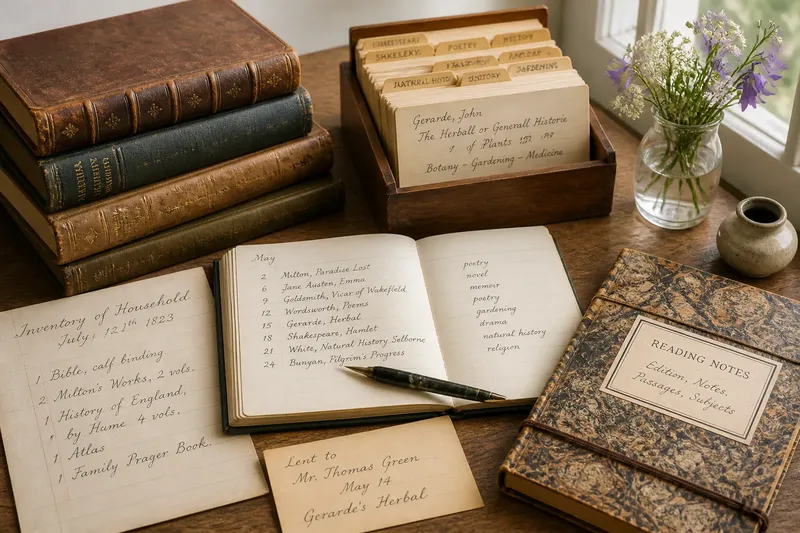
The Parts of a Personal Catalogue That Earn Their Keep
A personal catalogue works best when each entry names the title, creator, subject and location, so you can find a book without building a complex database.
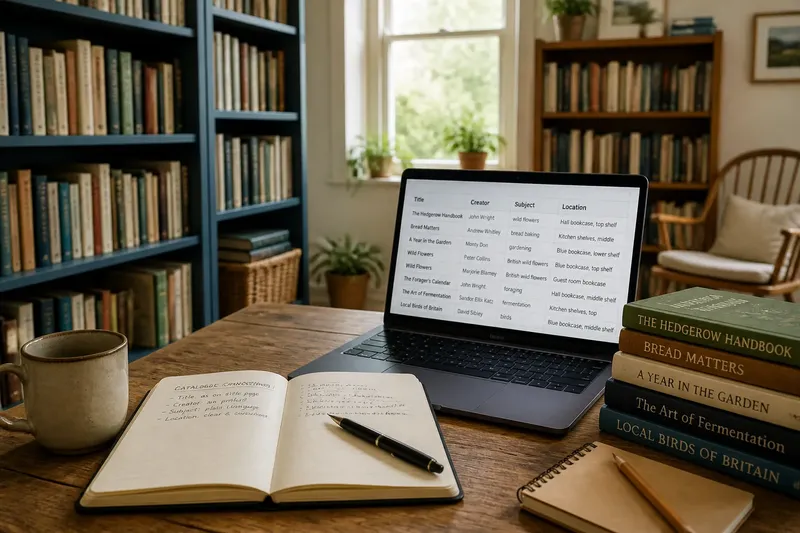
The most common catalogue mistake is recording every detail before deciding what you need to find; it costs time and leaves an impressive list that is awkward to use. A personal catalogue needs only a few consistent fields to help you locate a book, recall its subject and distinguish it from a similar title. The useful question is not “What could I record?” but “What would I search for?”
Choose fields that answer real search questions
Start with four fields: title, creator, subject and location. Together, they cover the most common searches: the name on the cover, the person responsible, what the item is about and where to retrieve it.
- Title: Record the wording that appears on the title page or cover. Keep subtitles when they help distinguish the book.
- Creator: Use the author’s name as printed in the book. For an edited collection, record the editor and identify that role.
- Subject: Choose a plain-language topic you would actually type or scan for, such as “bread baking” or “local birds”.
- Location: Note a shelf, cupboard or container name that you can recognise quickly, such as “hall bookcase, lower shelf”.
A few optional fields can earn their place if they solve a recurring problem. Add an edition note if you own confusingly similar versions, or a brief note if a book is borrowed and has a return arrangement. Resist fields that merely sound scholarly. If you never search by publisher, there is little reason to make it a required column.
Keep each field consistent enough to search
Consistency matters more than elaborate rules. If you enter “J R R Tolkien” in one record and “Tolkien, J.R.R.” in another, a simple search may not bring both entries together. Pick one form for creator names and use it throughout. You can write a surname first or follow the book’s cover; the helpful part is sticking with your choice.
Subjects need the same care. Decide whether you will write “vegetable gardening” or “gardening, vegetables”, then use that wording whenever it fits. Avoid creating a new label for every small variation. At the same time, do not force unlike books under a vague heading such as “general”. A short, familiar phrase is easier to remember than a miniature classification system.
For titles, keep the main wording in a predictable place. You might leave the opening article in place, or omit it when sorting alphabetically; either approach can work. Add a small note at the top of your catalogue describing the choice, so future entries follow the same pattern.
Use the first week to build a workable record
A short routine makes a catalogue easier to begin and maintain. Keep one notebook, spreadsheet or simple notes file as the single record, rather than scattering entries across several places.
- Day one: Choose the record format and create the four core fields. Use a spreadsheet if you want to sort and search columns; choose a notebook if you prefer writing beside the shelves.
- Day two: Pick a small, visible group of books and enter only the core details. This is a chance to settle the spelling and subject style before recording the whole collection.
- Day three: Add locations using names that match what you see in the room. If you call a shelf “blue bookcase”, use that label in every relevant entry.
- Day four: Try a few searches you might genuinely make: a creator’s name, a subject and a title fragment. Notice where your wording fails to bring up the item you expected.
- Day five: Adjust the fields or naming rule that caused friction. Do not add a new column until you can name a search it would improve.
- Day six: Record the next group, applying the revised conventions. Leave uncertain details blank rather than guessing.
- Day seven: Check a handful of entries against the books and correct any mismatch between the record and the item’s actual location.
Say you have two books called Wild Flowers, by different creators, in separate rooms. A title-only note could point you to the wrong copy. If you record each creator, use a subject such as “British wild flowers”, and name each room’s bookcase in the location field, searching by any of those details should narrow the choice and guide you to the right place.
Make location useful without turning it into a code
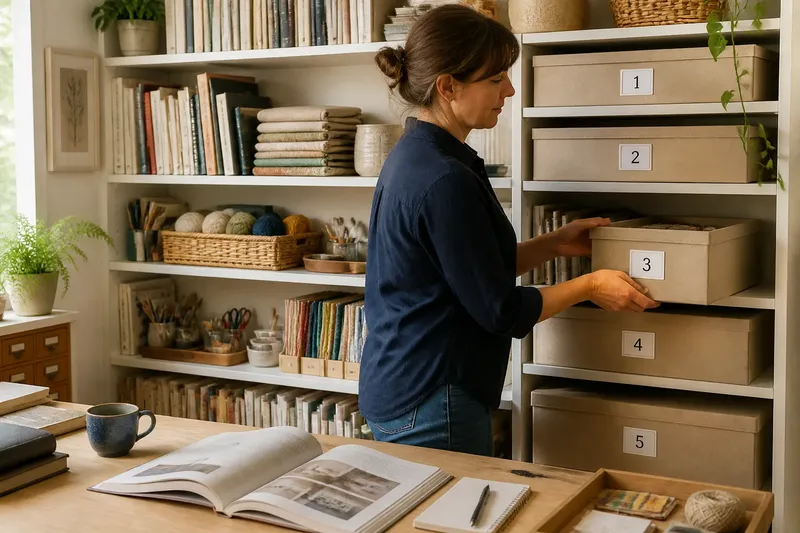
A location should be clear to the person who uses the collection, including you after a busy week. “Box 4” is useful only if the box has a visible label and that label still matches the catalogue. A phrase such as “desk-side crate” may be better if that is what you naturally call it.
When an item moves, update its location at the same time you put it away. If you cannot do that, keep a temporary note in one agreed place and clear it during your next catalogue session. Avoid maintaining a secret code in your head; the record should make the location understandable on its own.
What should a subject entry look like?
Should I use one subject or several?
Start with one clear subject for each book. Add another only when you would reasonably search for the item under both topics, such as “bread baking” and “fermentation”.
Do I need to record an ISBN or publication details?
Not for a basic finding catalogue. Add an ISBN or edition note only if you need to tell similar copies apart or locate a particular version.
What if I do not know the creator?
Leave the creator field blank or write “unknown” in the same way each time. Do not guess from a handwritten note or an incomplete label.
How often should I update the catalogue?
Update an entry when a book arrives, leaves or changes location. A brief, regular check is usually easier to sustain than waiting for a full reorganisation.
Let the catalogue stay small as it grows
Review the fields after you have used them for a while. If you repeatedly look for books by language, add that field; if you have never used a note column, remove it or leave it optional. A catalogue is a working aid, not a test of how much information you can collect.
For a personal catalogue, the best record is the one you can keep current and search in the words you naturally use. Put a short reminder of your naming conventions beside the notebook or at the top of the file. That small prompt can keep the next entry as easy to find as the first.